Dividend Stock Analysis: Exxon, Williams and Viper Energy Payouts
Exxon Mobil, Williams and Viper Energy reported Q3 results and declared dividends. Here are the payouts, yields and what analysts said about each business.
Key takeaways
- Exxon Mobil, Williams and Viper Energy each reported third-quarter results and announced a dividend, all within the energy sector.
- Exxon’s quarterly dividend of $1.07 a share is 3.9% higher and marks its 44th consecutive annual increase.
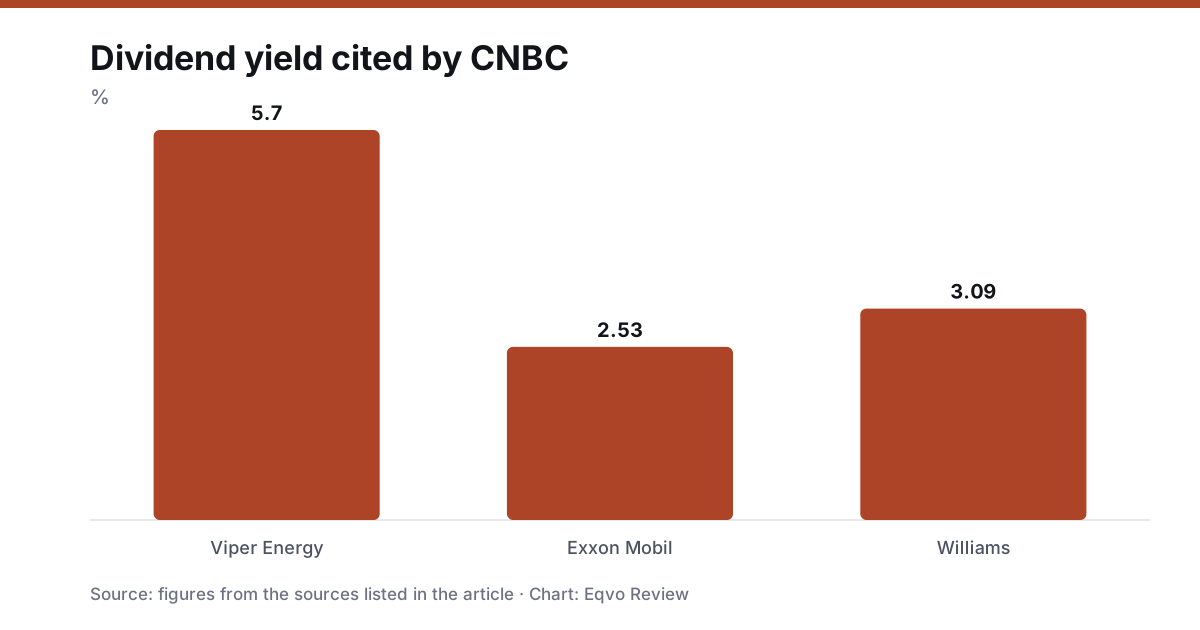
- Yields cited by CNBC range from 2.53% for Exxon to 5.7% for Viper, whose trailing figure includes variable payouts made under its earlier capital return policy.
CNBC framed the story around investors seeking steady income at a time when the AI trade is uncertain and the market may stay volatile after the midterm elections. This stock analysis sets out the payout data and the business drivers analysts highlighted. It does not rate the shares.
The payouts
| Company | Latest quarterly dividend | Payable | Yield cited |
|---|---|---|---|
| Viper Energy (VNOM) | $0.50 base | Nov. 19 | 5.7% (trailing, including past variable payouts) |
| Exxon Mobil (XOM) | $1.07 | Dec. 10 | 2.53% ($4.28 annualized) |
| Williams (WMB) | $0.525 | Dec. 28 | 3.09% ($2.10 annualized) |
Exxon Mobil: refining offsets Middle East pressure
Exxon reported strong third-quarter profits as its U.S. refineries raised output to capture high diesel prices linked to the conflict in the Middle East. TD Cowen’s Jason Gabelman pointed to refining strength offsetting regional headwinds. He also noted that Exxon increased its ownership in LNG projects, which he expects to cut its Middle East concentration over time from 75% to 50%. The company plans to keep buybacks at $20 billion for 2027, which Gabelman said reduces how closely repurchases follow the commodity cycle.
Williams: infrastructure growth
Williams, which operates natural gas infrastructure, posted results CIBC analyst Robert Catellier described as essentially in line with expectations. Higher transmission, storage and power generation revenue and the Momentum Midstream acquisition drove the quarter. The company kept full-year EBITDA guidance of $8.3 billion to $8.5 billion, with results tracking toward the high end, and targets EBITDA growth of at least 11% a year through 2030. Catellier cited projects including Transco’s Southeast Supply Enhancement II and an 84 MMcf/d expansion of the Garden Connector.
Viper Energy: royalty acquisitions
Viper, a Diamondback subsidiary that owns mineral and royalty interests mainly in the Permian Basin, reported production above TD Cowen and consensus estimates. It announced two royalty acquisitions for $809 million in cash, including deferred consideration, plus $82 million of newly issued shares. The deals are the McElroy Ranch purchase, closed in September, and the pending Buckhorn acquisition. The third quarter was also the first under Viper’s new return-of-capital framework, which pairs an increased $0.50 base dividend with opportunistic buybacks. TD Cowen’s Aaron Bilkoski said the deals add leverage but that Viper has capacity for opportunistic buybacks after its base dividend increase. He also said Viper’s production per share growth ranks among the highest in his royalty coverage.
What the payouts add up to
Annualized, Exxon’s $1.07 quarterly dividend comes to $4.28 a share and Williams’ $0.525 to $2.10. Viper’s $0.50 base payment would be $2.00 over a year. The three payment dates fall within about six weeks of each other, from November 19 to December 28, so the cash arrives in the same stretch of the quarter for holders of all three.
The businesses behind them differ. Exxon draws on refining margins and a global portfolio, Williams earns mainly from gas pipelines and storage, and Viper collects royalties tied to drilling by Diamondback and other operators in the Permian. Each is exposed to energy demand and commodity prices.
Reading the numbers
A yield compares the annual payout with the share price, so it moves whenever either changes. Viper’s 5.7% trailing yield includes variable payments made before its switch to a base-dividend framework, so it may not reflect the current $0.50 quarterly rate. Exxon’s long record of increases speaks to the company’s dividend policy, not to future payments. Analyst views reflect each firm’s own assumptions, and CNBC’s selection came from rankings compiled by TipRanks.
This article summarizes published commentary and is not investment advice.
Prepared with AI assistance from public sources and reviewed under our editorial policy. Not investment advice.