Latin America stock analysis: Citi sees best setup in decades
Latin American equities are beating the S&P 500 this year. A review of Citi's case for the region, the Brazil election risk and the threat of higher US rates.
Key takeaways
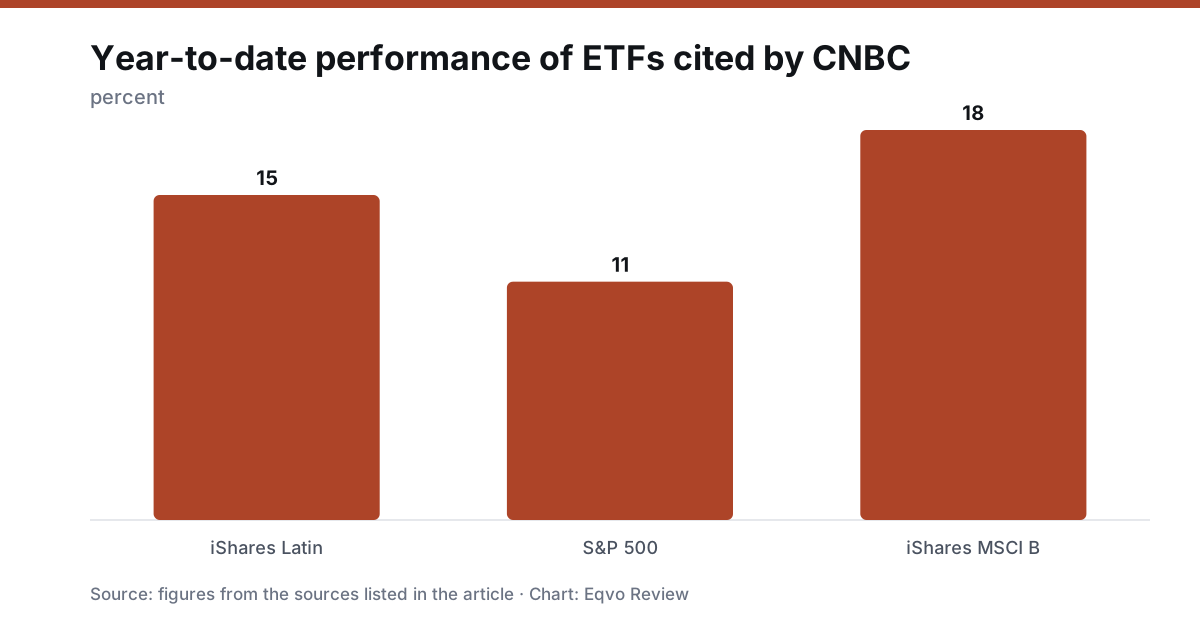
- The iShares Latin America 40 ETF (ILF) is up 15% this year against 11% for the S&P 500, and up more than 70% since late 2024, according to CNBC.
- Citi’s chief Latin America economist says conditions for faster regional growth are the best in decades.
- The main risk named is a continued rise in US interest rates; El Nino and an election in Brazil also loom.
- Citi’s equity analysts say part of the opportunity is already priced in.
The news
Latin American stocks are outperforming. In a CNBC column, Michelle Caruso-Cabrera cites a new Citi report by Ernesto Revilla, the bank’s chief Latin America economist. Revilla’s answer to whether the run can continue is a qualified yes, on the condition that countries use the moment.
The tailwinds he lists are a weak dollar, strong commodity prices, favorable geopolitics and a wave of elections that has put pro-business, pro-reform leaders in office. He ranks the weaker dollar first, since it draws money toward stronger currencies and makes dollar debt cheaper to service for regional borrowers.
| Fund | Year-to-date move |
|---|---|
| iShares Latin America 40 ETF (ILF) | Up 15% |
| S&P 500 | Up 11% |
| iShares MSCI Brazil ETF (EWZ) | Up 18% |
What is driving the sector performance
Real interest rates in the region are among the highest in the world. The Citi report points to carry as high as 10% in Brazil, which attracts fixed income and currency inflows while leaving room for rate cuts that would help equities. Revilla also credits central banks that control inflation better than in past decades.
There are country stories as well. The report says Mexico benefits from the AI boom through the export of CPUs assembled there, and Argentina is undergoing what it calls the most market-friendly shift in a generation. Danny Osorio, CEO of Andean Capital Advisors, told CNBC that private capital flows have been reenergized and that he sees money returning to Colombia, Peru, Ecuador and Argentina.
Politics adds to the picture. CNBC notes that Secretary of State Marco Rubio visited Colombia, Ecuador and Peru this month, reflecting the White House’s focus on the Western Hemisphere. Separately, citing the Financial Times and Morningstar, CNBC reports that European investors have already put more money into Latin American stocks in 2026 than in the past 16 years.
Brazil in focus
CNBC identifies the iShares MSCI Brazil ETF (EWZ) as the most liquid vehicle for the region, with $8.6 billion in assets and average daily volume of 23 million shares. Its largest exposures are mining (Vale), oil (Petrobras) and financials such as Itau Unibanco and Nu Holdings.
Brazil also holds the nearest event risk. The presidential election’s first round is October 4, with a runoff set for October 25. CNBC says a new poll showing Flavio Bolsonaro, seen as the more business-friendly candidate, neck and neck with President Lula da Silva led to a sharp rally in the Bovespa. It was the first poll to put Bolsonaro within reach of winning.
Risks
Osorio calls US interest rates the greatest threat: if the United States sneezes on rates, he said, Latin America catches pneumonia. Both he and Revilla flag El Nino, which is bringing droughts and flash floods that hurt agriculture in countries including Colombia and Peru.
Citi’s equity analysts caution that markets have run strongly and that part of the opportunity is reflected in valuations. They say earnings must improve for the rally to extend, and Andres Cardona, director of LatAm equity research, wrote that even a modest shift of global capital toward the region could have a meaningful effect.
What to watch
The Brazilian vote on October 4, the direction of US yields and whether regional earnings begin to justify current valuations. This article summarizes published research and reporting and is not investment advice.
Prepared with AI assistance from public sources and reviewed under our editorial policy. Not investment advice.